
When I started researching my own mommy makeover, the first question I typed was "how much does it cost in Mexico." The results were useless. Every clinic page showed a number that left out half the costs, and every forum thread devolved into people arguing about whether going abroad was safe.
I spent four months working out what it actually costs, all in. This is that breakdown.
The US baseline first
Before you can evaluate what surgery abroad costs, you need a clear picture of what you would pay domestically. In the United States, a mommy makeover is built from three separately-billed fees.
The surgeon's fee is the largest single cost. It covers the surgeon's time and expertise and varies based on reputation, location and the complexity of your case. Expect $6,000 to $18,000 for a combination procedure. Board-certified surgeons in major cities sit toward the top of that range.
The facility fee covers the operating room, surgical supplies and nursing staff. A full mommy makeover takes four to six hours under general anesthesia, and most facilities bill by the hour. Expect $2,000 to $5,000, with hospital-based surgery running higher than a private surgical suite.
The anesthesia fee is billed per hour and covers both the drugs and the anesthesiologist or CRNA. For a four-to-six-hour case, expect $1,200 to $3,500.
Add those together and a typical US mommy makeover runs $9,000 to $20,000 according to the American Society of Plastic Surgeons, with an average around $18,101 based on 864 patient-reported cases on RealSelf. Complex cases with multiple procedures in a hospital setting can reach $28,000 to $33,500, which is RealSelf's own reported top end. A surgeon in Austin quoted me $26,500 for the tummy tuck alone, before the breast lift.
There is usually no package. You pay each provider separately, and your post-op garments, medications and follow-up visits are billed on top.
If you still need the basics on what procedures a mommy makeover actually combines, that is worth reading first.
What surgery abroad actually costs
The same combination of procedures, performed by a board-certified plastic surgeon in an accredited facility, costs significantly less overseas. Here is a realistic range by destination, using multi-clinic invoice and review data wherever I could find it rather than a single clinic's own asking price.
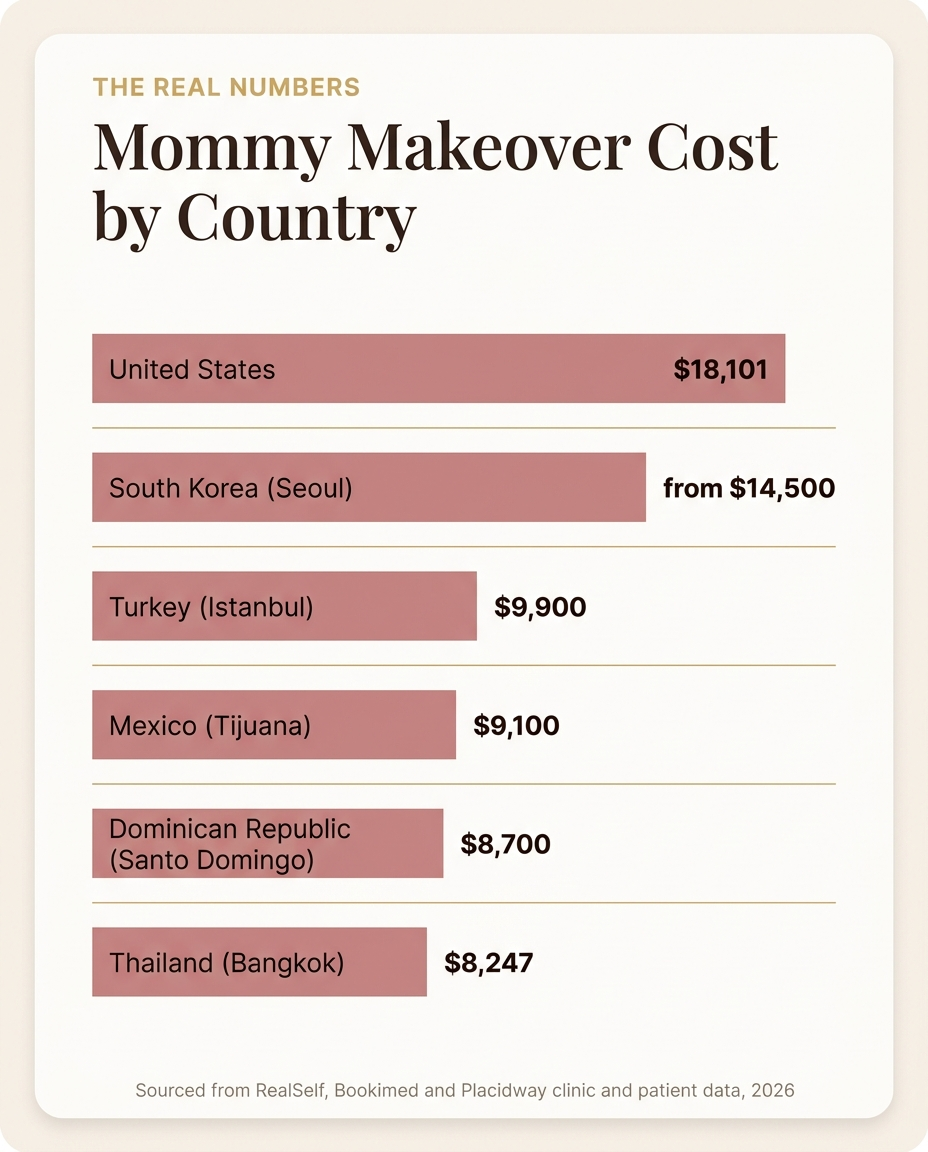
Mexico: $6,000 to $14,000, averaging $9,100. That average comes from a 2026 survey of 16-plus verified Tijuana clinics. Tijuana is popular with California patients because of the short drive across the border. Guadalajara and Cancun run in a similar band, typically $7,000 to $13,000 depending on the clinic and how many procedures you combine. Patients typically save 50 to 60 percent versus US pricing.
Dominican Republic: $5,500 to $8,700 on average. Santo Domingo's average, drawn from patient quotes across clinics tracked worldwide, sits notably below both Mexico and Turkey, with savings of 50 to 70 percent versus US pricing. This is also the market where sources most explicitly flag verifying ICU access and a documented hospital transfer agreement before you book, given CDC-reported complications from cosmetic surgery abroad generally.
Turkey: $5,900 to $16,500, with a median around $9,900. That figure comes from real patient invoices across 184 clinics worldwide, tracked and updated monthly, not a single clinic's marketing page. Istanbul clinics have moved heavily toward all-inclusive packages covering surgery, one to two hospital nights, hotel accommodation and airport transfers. Turkey welcomed 1.3 million medical tourists in 2024, and high surgical volumes have produced genuinely skilled surgeons, many of whom completed fellowships in Europe and hold ISAPS or EBOPRAS certification. Savings run around 56 percent compared to the US.
Colombia: $6,000 to $12,000. Bogota, Medellin and Cali have well-established medical tourism infrastructure and strong reputations, particularly among Latin American patients and increasingly among US patients seeking Spanish-speaking care. Savings run 40 to 70 percent versus US pricing.
Thailand: $4,500 to $12,000, averaging $8,247 in Bangkok. JCI-accredited hospitals in Bangkok and Phuket offer high-quality care with English-speaking staff and ThPRS-certified surgeons, though the long flight distance requires careful planning around the flying-home timeline. Savings run around 50 percent compared to the US.
South Korea: $14,500 to $26,000. Seoul sits at the premium end of the medical-tourism spectrum, closer to UK pricing than to Mexico or Turkey, but still around 42 percent below the US average. What you are paying for is depth: KOIHA and MOHW-accredited hospitals, surgeons who are frequently ASAPS or ISAPS members, and clinics with multi-decade case volumes in the tens of thousands.
India: $4,000 to $7,000. The most affordable option on this list, with internationally trained surgeons and NABH or JCI-accredited hospitals in Delhi, Mumbai and Bangalore, though follow-up logistics are more complex given the travel distance. Pricing data here is thinner than for the other markets on this list, so treat this range as directional rather than a tight average.
These are surgery prices only. The calculation gets more interesting when you add travel.
The full all-in cost: what you actually spend
The surgery price is the starting point, not the ending point. Here is what a realistic trip includes.
Flights. Budget $400 to $1,100 return, depending on your destination and how far in advance you book. Mexico is cheapest if you are in the US. Turkey is more economical for European patients. For the return flight, business class is worth considering if the budget allows: more legroom, easier to rest with your legs elevated. Add $300 to $800 for the upgrade if you go that route.
Accommodation. Most surgeons ask you to stay 10 to 14 days. A serviced apartment near the clinic is better than a hotel because you have a kitchen and room to move around. Expect $50 to $130 a night, or $600 to $1,600 total for two weeks. Some Turkish clinics include hotel nights in their package price, so read the small print.
A companion. Strongly recommended for the first five to seven days. You should not be alone while your drains are in, and you will need help getting in and out of bed, preparing food and managing medications. Factor in a second flight and a share of accommodation costs.
Post-surgical garments. Your compression garment is critical for recovery and seroma prevention. Some clinics include one in the package; others charge $80 to $150 separately. Buy a backup before you travel, because sizing can be unpredictable after surgery swelling.
Pharmacy and aftercare. Pain medication, antibiotics, wound care supplies and arnica for bruising. Budget $100 to $300 depending on what the clinic provides versus what you pay out of pocket.
Meals and local transport. Two people eating for 12 days, plus taxis to follow-up appointments. Budget $400 to $700.
A real all-in example
A tummy tuck plus breast lift in Mexico, adding everything honestly:
| Item | Cost |
|---|---|
| Surgery (tummy tuck + breast lift) | $5,900 |
| Return flights for two | $1,050 |
| 12 nights serviced apartment | $960 |
| Aftercare, garments, pharmacy | $280 |
| Meals and local transport | $420 |
| Total | $8,610 |
A US surgeon quoted me $26,500 for the tummy tuck alone. At $8,610 for two procedures plus a twelve-night stay in Mexico, the trip cost less than a third of the domestic single-procedure quote.
One patient on RealSelf reported paying roughly $7,500 all-in for a tummy tuck, liposuction and breast lift in Mexico, while her US quotes had been $18,000 to $22,000. Her clinic included airport pickup, hotel accommodation and daily aftercare nurse visits in that price.
What "all-inclusive" actually means
Turkish and some Mexican clinics heavily market all-inclusive packages. Before you read that phrase at face value, check what each item actually covers.
Usually included: surgeon's fee, anesthesia, facility and hospital stay (typically one to two nights), post-operative medications during your stay, airport transfers, and sometimes hotel accommodation for a set number of nights.
Usually not included: your flights, additional hotel nights beyond what the package specifies, compression garments beyond the one provided, any follow-up care after you return home, and revision work.
Ask every clinic for an itemised quote rather than a single package figure. This is the only way to compare clinics on the same basis rather than on headline numbers that mean different things.
The complication cost: what no one advertises
A survey by the American Society of Plastic Surgeons found that 80 percent of responding surgeons had treated patients for complications following surgery abroad. The complications included infection, wound separation, seroma, excessive scarring and contour irregularities.
This does not mean surgery abroad is inherently dangerous. It means that choosing poorly dramatically increases your risk, and fixing a bad result domestically is expensive. A revision procedure in the US typically costs $8,000 to $18,000. Treating an infection or seroma means additional time off work, additional care costs and the possibility of permanent changes to your outcome.
UK patients who develop complications abroad typically discover that the NHS will treat them but that travel insurance and private health insurers rarely cover complications from elective cosmetic surgery performed overseas. US health insurance similarly will not cover cosmetic revision work. If something goes wrong, you pay out of pocket.
None of this is an argument against going abroad. It is an argument for doing the same due diligence you would apply to any significant medical decision. Recovery, not just surgery cost, is the other half of that decision, and I have written a full week-by-week account of what to genuinely expect.
What separates a safe result from a dangerous one
Board certification verified directly. In Mexico, look for surgeons certified by the Consejo Mexicano de Cirugía Plástica, Estética y Reconstructiva (CMCPER). In Turkey, look for certification by the Turkish Plastic Surgery Association and international membership such as ISAPS or EBOPRAS. In the Dominican Republic, check for SODOCIPRE membership. In Thailand, look for ThPRS certification, the Thai Society of Plastic and Reconstructive Surgeons. In South Korea, look for KSPRS or ASAPS and ISAPS membership. Do not rely solely on what the clinic website says. Cross-reference against the official medical board registry for that country.
Facility accreditation. JCI (Joint Commission International) is the gold standard for international hospital accreditation. It applies the same standards used in US hospital accreditation. Some well-regarded clinics operate in non-JCI facilities with equivalent national accreditation. A clean, photogenic clinic is not an accreditation.
A video consultation before you commit. Your surgeon should be willing to speak with you before you book. Any clinic that discourages pre-booking consultations or routes every enquiry through a coordinator rather than the surgeon is telling you something about their process.
Post-operative access protocol. Ask specifically what happens if you develop a complication after you fly home. A reputable clinic will have a named contact you can reach, a willingness to consult remotely via photos, and a clear referral pathway for urgent care. The clinics I would send my own friends to have this established before you ask.
Why the price gap exists
Lower cost abroad does not mean lower-quality care. The price difference comes from three structural factors: lower surgeon malpractice insurance premiums, lower facility operating costs and a lower general cost of living. These are overheads, not quality indicators.
The surgeons running the best clinics in Mexico and Turkey trained in the same universities, completed the same fellowship programs and operate with the same instruments as their US counterparts. What is different is what it costs them to run their practice, and that difference gets passed on to you.
The gap in outcomes between high-quality care abroad and high-quality care at home is not clinically significant. The gap between high-quality care abroad and low-cost care abroad is significant, and it is the thing worth your research time.
The cheapest quote is rarely the best value. The clearest, most itemised quote almost always is.
If you would rather not build a 47-tab spreadsheet the way I did, the free concierge is exactly what it sounds like. Tell me your procedures, your budget and your timeframe, and I will match you with the clinic I would choose for myself.